Mostly unedited entries from a journal I kept during the Hukaung Valley Rattan Survey (see Hukaung Valley Rattan Survey and HKV Rattan Survey.pdf). [NOTE: To read chronologically, start at the bottom with the January 04, 2005 post.]

Monday
19Oct2009

January 21, 2005

Mile 21 Camp, 3:29 PM

Wonderful to wake up in a tent, a bit cold outside but cozy in your sleeping bag, and look up and see mist-covered mountains in the largest continuous tract of tropical forests in S.E. Asia. Padded out in my flip-flops and Polartec jacket to have a hot cup of tea.  The fires had already been started and breakfast was on the way.  This is the life.

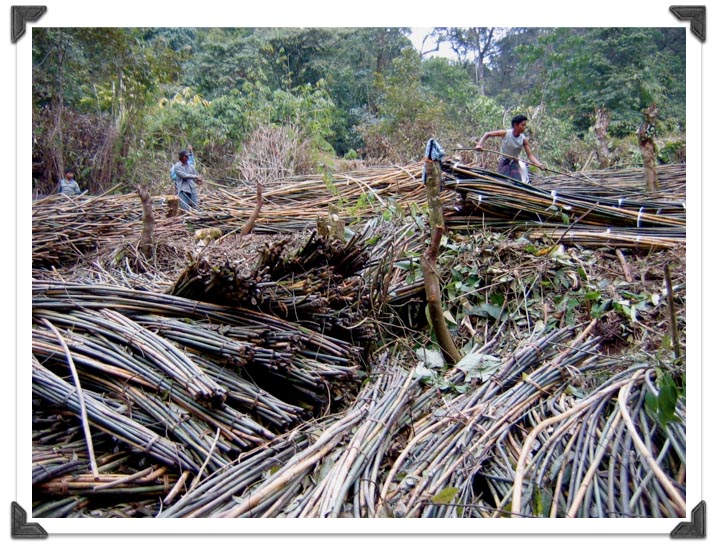
Left camp after breakfast this morning and headed back up the road - the downhill section effectively becoming uphill again - for about a mile and a half until we ran into a group of six rattan collectors.  A friendly lot, and we got loads of information about species, quantities, and prices.  While we were chatting, a flock of five hornbills flew by overhead.  Have never seen a flock of hornbills; a bit like seeing five Rafflesia flowers (see Corpse Flower) in one day. The collectors told us about a large diameter cane that they were collecting, "kadin", and agreed to show us where we could get a specimen. They had gone into the forest eight miles yesterday to collect  "yamata" rattan.   The were intrigued by our method of collecting specimens and hung around until we started doing our transect.   I have some black flies biting me as I write this, each bite drawing a small drop of blood.  I've just returned from a bath and have shorts on, but I think I 'll go put on some long sleeves and long pants to stop the bugs.

3:48 (con't).

Back with pants and jacket.  The place where the rattan collectors took us was close by and perfect for a transect.  We counted five separate species in the plots and made two collections, both of them new and unknown rattans. This will be my high elevation transect at 1040 masl. It's amazing how far up rattans can grow and still maintain such high diversity. It's also amazing how we keep finding new rattans in these forests.

After finishing our transect we had a "picnic" lunch along the road. Since we have been on this section of the road from Namyun to Shimbweyang, with the exception of the truck we came in, we haven't seen one vehicle.  A couple of dozen women carrying large baskets of stuff, and a handful of men on scooters laden with rice sacks, one team of rattan collectors, and a couple of army guys...but not one vehicle.  Roads without cars aren't so bad.

Back at camp, Andrew and I went to bathe under the bridge where ice cold water pours out of a bamboo pipe. Very brisk, but I did manage to bathe and, as a gesture to Case's admonition "to not come back with a beard", I even shaved. The sun is going down now and it's time to take down the solar panel which I had left on the roof of the tent all day charging camera batteries. The sun was blazing so well today that I managed to charge up my camera battery and after we returned from the field I plugged in one of Andrew's batteries and managed to charge it, too. It's a great system as long as it doesn't rain.

I hear the cooks chopping away preparing our dinner and now that Andrew and I are both clean, we have some plants to press. A relaxing evening in camp.  And now the moon is full.

7:37 PM (con't).

While we were in the field, the kitchen crew made a picnic table and benches for eight people out in front of our camp. It is made entirely of bamboo and rattan and took three of them 2 hours to make.  We pressed plants on it this afternoon and they prepared a sumptuous candlelight dinner on it this evening. It will be a nice gift to leave for the next travelers that visit Mile 21 camp. The temperature has already dropped to 6º C. It's going to be a cold night...


Friday
24Apr2009

January 20, 2005

Namyun Town Hall, 8:47 AM

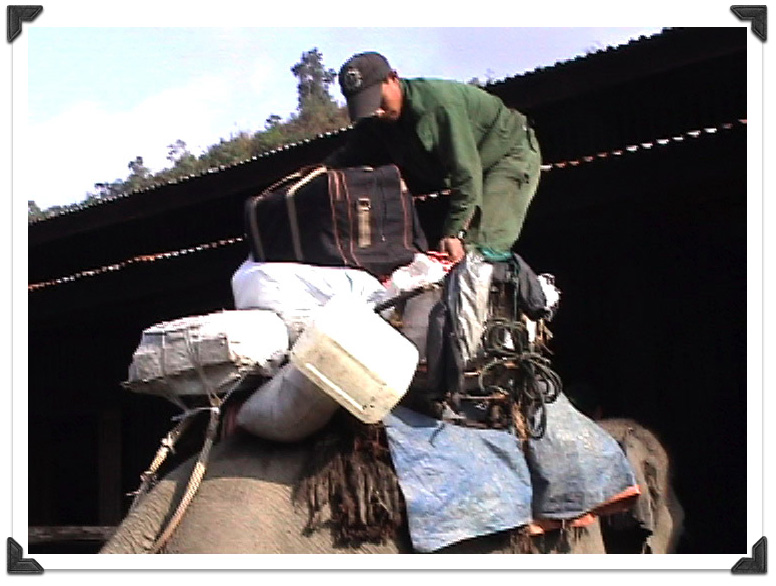
It rained like crazy last night, and the pounding on the corrugated roof was deafening.  I wonder what it would be like to be in a tent in a storm like that? Fortunately, the sun is out this morning and there is a lot of blue sky.  The elephants have shown up and are now saddled and awaiting our baggage.  We've got 11 miles to walk today and it looks like it's going to be a beauty.

8:30 PM, Mile 21 Camp (N26°53', E96°12')

I am writing this by candlelight in my new L.L. Bean tent at Mile 21 between Shimbweyeng and Namyun on the Ledo Road. There's almost a full moon and the sky is clear so the moonlight is filtering through the skylight of my tent. I have positioned my sleeping bag to be able to look up at the moon before I go to sleep.  The only sounds I hear, besides the guys telling jokes around the fire in front of the palm hut where they are sleeping, is Aumbu's bell as she forages along the side of the road and up into the forest.

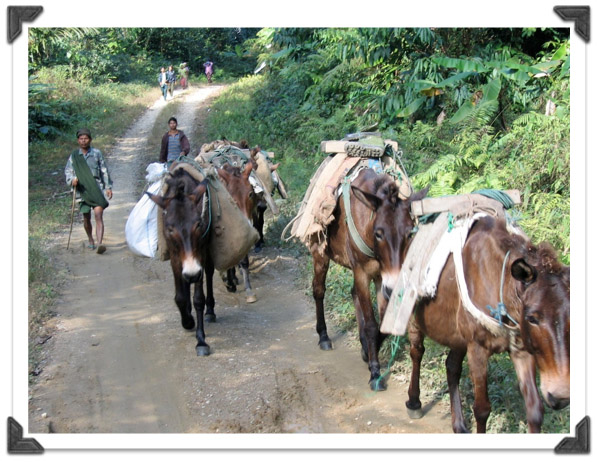
Today's agenda was walking.  We packed up the elephants and left Namyun around 10:30 AM. And then we walked. And walked. And walked until about 5:00 PM.  The good news is that it didn't rain - until we had almost arrived to camp. The weather was cool and clear like Fall in New England, the roadside was covered with beautiful forest, the vistas were gorgeous, I had a good walking stick, my boots were broken in, and my water bottle was filled with Oralite (re-hydration powder). The bad news is that we walked 11 miles uphill, climbing from 300masl to 1100masl.  Around every bend was another uphill stretch.  All together, I think we walked up about 2500 feet in elevation.

When we arrived, everyone was thrashed but we hurried to set the tents up because it was getting dark.  Myint Maung, Andrew, and I are in tents.  The rest of the crew is sleeping on the split bamboo floor of the 5 X 30 foot palm-thatched "hostel" that serves travelers here that need a place to stay. Every 10 feet or so is a fire pit, and the kitchen is at the far left of the structure.  My dome tent was a bit confusing to set up at first.  It was getting dark, and we were hurrying, and we got the rain fly on backwards, and the poles wouldn't fit, and the elephants were getting dangerously close to see what was happening..., but everything finally came together and the tent is a beauty.

The cooks prepared a wonderful dinner, and the Army officer from the military post down the road came to chat and stayed for dinner.  The poor man is probably starved for company.  He brought us some pickled, wild boar meat as a gift.  Not sure what everyone was saying, but they were laughing hysterically and Kyaw Lwin, who is usually very quiet, was the life of the party.

The plan for tomorrow is transects and collecting whatever we find. And the same for the day after that. We'll move down the road and make another basecamp at some point, but for now, we just got here, my tent is cozy, and we'll probably spend several days here until the forest stops yielding surprises.  Time to take my pills, brush my teeth, and go to bed.  I'm thrashed, as well.

Saturday
11Apr2009

January 19, 2005

Namyun Town Hall, 4:20 PM (N26˚59', E96˚10')

Something amazing happened today.  While we were in Tanai, the kitchen crew got plastic cups for everyone. They were all different.  Mine was white with flowers and a tight fitting lid for keeping your tea hot.  I wrote my name, the date, and the location on the bottom of the cup. In transit to Namyun we stopped at the camp at mile 18 for lunch.  After lunch we made tea, started talking to the locals about rattan, and then went outside to look at some plants.  On arrival to Namyun I looked in my pack and couldn't find my cup.  I had left it in the lady's house at mile 18. One of the crew graciously gave me their cup - hot pink with no lid. I was appreciative, but I missed my cup (I get attached to things...).

This morning, one of the cooks came up with a big smile on his face and gave me a blue plastic bag.  Inside was my cup.  The lady had noticed that the American had left his cup and she knew that we were headed to Namyun, so she gave it to the first motorcyclist that stopped on the way to Namyun with instructions to give it to the group with the Americans. I'll say it again. You gotta love these people...

We left walking up the road to Pansaung this morning with the idea to do some collecting and maybe do a transect if we found a nice piece of forest. The sky was very overcast, and the mountains were covered in clouds.  We had decided not to go all the way to Pansaung the night before because of the rain.  We knew that a truck ouldn't make it now, and we didn't feel that the flora wold be different enough to merit walking the 30 miles.  After walking for about 15 minutes, it started raining, and it rained on and off all day.  We ended up walking about 3 miles up the road, climbing 250 meters in elevation and collecting three palms, but the constant rain made everything a little tedious. We went back to Namyun about 3:30 PM, pressed the days collections, and hung up our wet stuff to dry. No bath today.

I think the plan for tomorrow is to pack up our stuff, load up the elephants, and head south to mile 21 to make a base camp. If the weather clears - and it looks like it will - we should be able to make some nice collections and do some transects because the forest is fantastic along this part of the road. I am very much looking forward to finally doing some camping.  Andrew just gave me the collecting total so far.  We've collected 15 rattans, 14 of them Calamus. This is about twice what we expected to find. There's probably still a couple of rare ones out there waiting to be collected. 

Wednesday
28Jan2009

January 18, 2005

Namyun Town Hall, 9:50 PM (N26˚59', E96˚10')

Now we are really getting out there. A white, 4-wheel drive Toyota truck arrived to the Shimbweyeng Guest House promptly at 8:30 this morning to take our crew the 30 miles up the road to Namyun in Sagaing Division. The truck was a simple pick-up with side bars and had none of the seats in back like our previous rides. The crew loaded all of our stuff into a single layer in the back of the pick-up bed and put our personal bags on top of the cab. They then laid a thick piece of plastic over all of the bags, roped everything down good and tight, and we all piled in. Andrew up front in the passenger's seat by the driver and everybody else in back. It was pretty soft and cozy, at least for the first hour or so.

This part of the Ledo Road is esentially a two-track trail which is only passable because it hasn't rained for several weeks. There are inclines in places in excess of 45˚, narrow shoulders with steep cliffs, WWII vintage wooden bridges (see A Bridge Too Far), several river crossings, and lots of muds and bumps. Both sides of the road, for most of the six hour trip, are covered with beautiful, closed forest full of rattan. For six hours, we drove through the forest listening to the whoops of gibbons; we didn't pass one settlement. Two military camps, one at Mile 7 and the other at Mile 18, but essentially just endless stretches of forest.

A few culinary notes. This morning for breakfast the kitchen crew made a mustard leaf soup. Very tasty, but so spicy that I couldn't eat it. Hard to believe that they served it as a soup. It was so hot, it would seem more appropriate to put it in a small bottle to sprinkle sparingly on eggs or casseroles like Tabasco sauce.  We stopped for lunch at the military camp at Mile 18, and had a delicious pickled tea leaf and crunchy peanut dish in one of the four compartments of our Tupperware container.

We are currently stationed in a large wooden building with a corrugated roof and concrete floor that serves as the town hall. Everyone is sleeping on the floor. We got a brief rain shower after arriving to Namyun, but it seems to have stopped.  Andrew and I are going to walk down to the river to inspect the bathing facilities.

6:08 PM

The river looks extremely cold.  Namyun seems to be a very pleasant mountain village. There are several stores and a couple of coffee shops, and the houses are all built of wood and up on stilts. The dominant feature of the village, however, is the cloud covered, forest-laden mountain that looms in the background.


Saturday
24Jan2009

January 17, 2005

Shimbweyeng Guest House, 9:16 AM

Took a walk early this morning to the end of town to get some pictures of Shimbweyeng emerging from the morning fog.  All the village cows sleep in the middle of the street. I love the sights and sounds of a rural village waking up. The first morning fires, the sound of water splashing on faces, the slap of flip-flops on concrete floors, the lone putt-putt of a motor scooter. I got some nice photos.

During breakfast we talked with the Education officer from Namyun township about local rattans. Learned several interesting things. First, that we have arrived right in the middle of the rattan collecting season, and that we would pass several rattan collector camps on the road to Namyun.  Second, we were told that there were probably more species of rattans in the mountains than in Shimbweyeng, meaning that we still have a lot of new things to inventory and collect.  Finally, we learned that most of the merchantable rattans in the forests along the Ledo Road have already been harvested and that the populations are now regenerating. [NOTE: This is exactly what what our first transect seemed to indicate].

5:24 PM

We've had a marvelous afternoon. After breakfast, we learned that the 4-wheel drive truck had just left Tanai and that the elephants had not yet arrived, but would later in the day. We decided to spend another night in Shimbweyeng and get an early start to Namyun tomorrow. We had already done transects in this forest type, so we decided to walk further north on the road and see if we could do some collecting. The cooks prepared a lunch for us and we set out walking north about 10:30 AM.

We walked for about three miles  and then came upon a magnificent specimen of Plectocomia, a large cane rattan known as elephant cane or "sin kyein". It was growing on a very steep slope, but our assistants said "no problem" and they set out scrambling up the slope to fell the rattan and drag it back to the road. They cut the stem and pulled and pulled, but the enormous, spiny whips (cirri) were firmly attached to the neighboring trees. The cut several of the surrounding stems, but the rattan refused to budge. At this moment, what should we see lumbering down the road but Luemai and Aumbu, our two elephants (see A Bridge to Far and Bathing the Elephant), and their handlers. They quickly sized up the situation, hooked Aumbu up to the rattan, and he easily pulled the whole 20 m cane out of the forest and into the road where we could work on it. This may be the first rattan specimen ever collected by an elephant (see Hukaung Valley Rattan Survey for video documentation). The whole thing was additionally exciting  because Andrew said that he had seen this rattan in norther India, but couldn't collect it, and that it was an undescribed species. Aumbu may have collected a type specimen.

We then took a break for lunch and walked down to a beautiful river with sandy beaches and fern-covered banks. A family had made a temporary house near the river while the father was collecting Livingstonia leaves to sell for thatch.  It was a beautiful sunny day and the forest along the river was filled with huge trees. The river, the forest, the lunch, and the elephants made the whole interlude very, very special.

After lunch we were able to make two other collections, both of them new records for Myanmar. About 3:00 PM we loaded up our collecting sacks and started the long walk back to Shimbweyeng.

We seem to have fallen into a pattern after several days here.  We come back from the field, we take a freeezing splash bath, we press the day's collections while sipping a cup of tea or coffee, and then, with a hot plate of roasted peanuts from the kitchen crew, I start to work writing in this journal while Andrew review's the day's photographs. At about 7:00 PM we have dinner, and very shortly thereafter, head to bed.

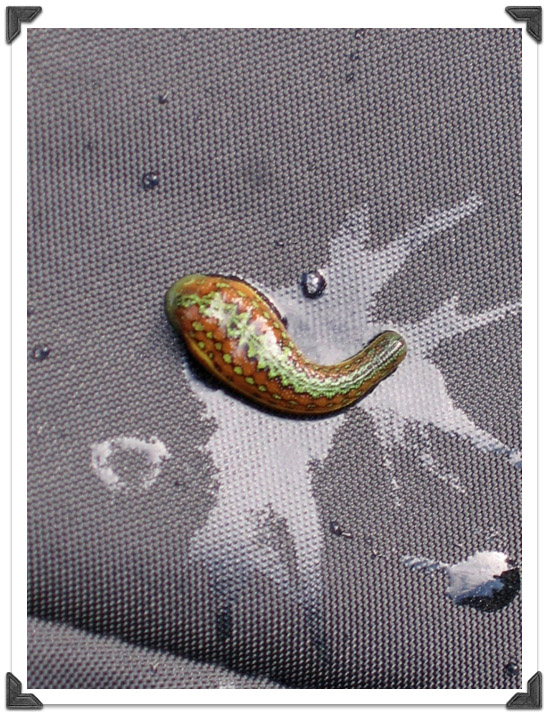
The plan for tomorrow is to proceed to Namyun in the truck.  We have sent the elephants on ahead and we will use them on the way back from Namyun. The idea is to make two or three base camps between Namyun and Shimbweyeng, and to spend several days  at each site collecting and running transects.  I also pulled a leech off my  ankle today. I only noticed it after pouring a bucket of water on my leg during my bath and noticing the blood.